Autism statistics: the numbers that matter for early identification
Autism statistics circulate widely with the year stripped off, which is how outdated numbers survive for a decade. This page keeps each figure attached to its source, its survey year, and what it does and doesn't mean.
Prevalence
1 in 31
8-year-old children identified with autism (32.2 per 1,000)CDC ADDM Network, 16 sites, 2022 survey year, published 2025
1 in 19 → 1 in 103
Range across communities — California's highest site vs. Laredo, Texas (53.1 vs. 9.7 per 1,000)CDC ADDM Network, 2022
3.4 : 1
Boys to girls — narrowing from 4.2:1 (2018) and 3.8:1 (2020)CDC ADDM Network, 2022
~1 in 100
Global estimate for children worldwideWorld Health Organization
How to read the prevalence number. A five-fold difference between communities is not a real difference in how many autistic children are born there — it mostly reflects how thoroughly each community screens, evaluates, and documents. Rising prevalence over the decades likewise reflects broader diagnostic criteria, better recognition, and improved access more than a change in underlying occurrence. The practical reading: in well-served communities, roughly 1 in 20 children is identified — which tells you how ordinary this is, and how much identification depends on whether anyone looks.
Age of identification — the gap
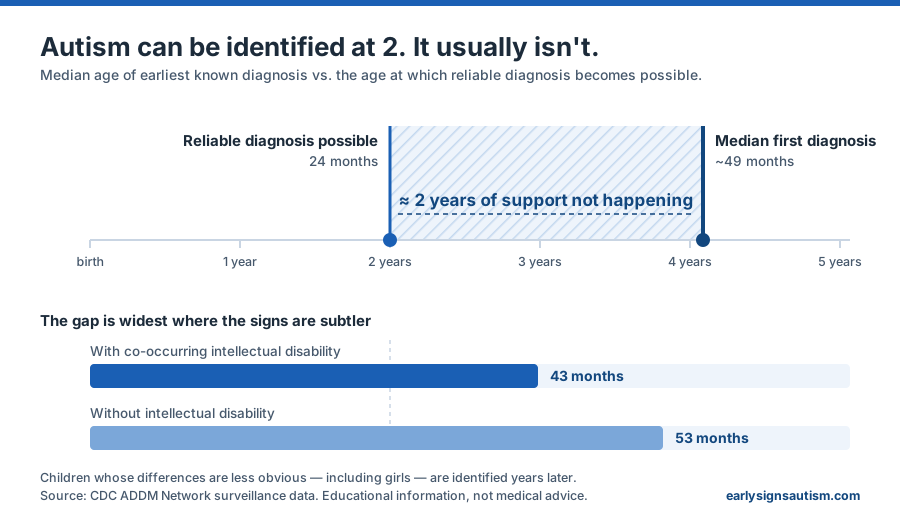
by age 2
Age at which a diagnosis by an experienced clinician can be reliable and stableEstablished in longitudinal research; reflected in AAP guidance
~49 months
Median age of earliest known diagnosis — roughly age 4CDC ADDM Network, 2020 survey year
43 vs. 53 months
Median diagnosis age with vs. without co-occurring intellectual disability — subtler presentations are found years laterCDC ADDM Network, 2020
improving
Children born in 2018 were more likely to be identified by 48 months than children born in 2014, at 13 of 15 sitesCDC ADDM Network, 2022
This gap is the reason this website exists. Autism can be identified at 2 but is typically identified around 4 — two years in which support could have been running. The gap is widest exactly where signs are subtler: children without intellectual disability, and girls, are found latest. That is not a small statistical footnote; it is the difference between starting communication support at 2 and starting at 5. The 2022 data does show the gap narrowing, which is evidence that screening programs work.
Co-occurring conditions and profile
39.6%
Of 8-year-olds with autism and cognitive data available, share classified as having co-occurring intellectual disability — meaning roughly 60% are notCDC ADDM Network, 2022
~1 in 4
Autistic children who show a loss of previously acquired skills, typically between 15 and 24 monthsConsistent across published regression studies
Screening: recommended vs. reality
The American Academy of Pediatrics recommends general developmental screening at 9, 18, and 30 months and autism-specific screening for every child at 18 and 24 months. In practice, screening is not universal — many children reach preschool without ever having been formally screened, and follow-through after a positive screen is inconsistent. Among 4-year-olds identified with autism in the 2022 data, 72% had a first evaluation by 36 months, which means more than a quarter did not.
The parent-side conclusion is simple and is the single most actionable line on this page: do not assume screening happened. Ask for it by name. See how screening works and what the M-CHAT-R/F is.
Citing this page — journalists, students, and clinicians are welcome to use these figures. Please cite the primary sources listed below directly; if you want to point readers to this compilation:
"Autism Statistics: Prevalence, Diagnosis Age & Early Identification." Early Signs Autism, https://earlysignsautism.com/statistics (accessed [date]).
Questions or a correction? Corrections are welcome and are made promptly — see the editorial policy.
What no statistic can tell you: whether your child is autistic. Prevalence figures describe populations; your child needs observation, screening, and — if indicated — an evaluation. Start with the signs by age.
Sources
- Shaw KA, Williams S, Patrick ME, et al. Prevalence and Early Identification of Autism Spectrum Disorder Among Children Aged 4 and 8 Years — Autism and Developmental Disabilities Monitoring Network, 16 Sites, United States, 2022. MMWR Surveill Summ 2025;74(2). cdc.gov/mmwr/volumes/74/ss/ss7402a1.htm
- Maenner MJ, Warren Z, Williams AR, et al. Prevalence and Characteristics of Autism Spectrum Disorder Among Children Aged 8 Years — ADDM Network, 11 Sites, United States, 2020. MMWR Surveill Summ 2023;72(2). cdc.gov/mmwr/volumes/72/ss/ss7202a1.htm
- CDC. Data and Statistics on Autism Spectrum Disorder. cdc.gov/autism/data-research
- CDC. Autism Prevalence Varies Across US Communities. cdc.gov/autism/articles/prevalence-varies-across-us-communities.html
- World Health Organization. Autism — fact sheet. who.int
- American Academy of Pediatrics — developmental surveillance and screening recommendations, via healthychildren.org
Medical disclaimer: Educational information only — not medical advice. Figures are reproduced from the sources named above and re-checked periodically; where a survey year is given, the figure describes that year, not today.